



October 15, 2026
A private dental practice should raise its fees once a year, by a modest 3 to 5%, effective January 1.
The work to raise your fees starts now. October through December gives you time to check your numbers, set the new fees and prepare your team before the new benefit year begins.
A quick test: can you name the date of your last fee change? If not, start there.
|
THE SHORT TAKE
|
What Has Changed Since 2021
Most owners know costs have gone up. Fewer have lined that up against their fees. Since January 2021, according to the ADA Health Policy Institute:
- Dental supplies and equipment: up 23%.
- Dental office staff wages: up 21%.
- What practices are paid, across all payers: up 19%.
- Overall inflation: up 27%.
A fee you have not changed since 2021 buys about 21% less today.
Why Raise Fees Every Year?
Patients rarely react to a small, predictable change. What they notice is the catch-up: three flat years, then a double-digit jump. An annual rhythm also makes the conversation routine for your team.
On a practice collecting $1.2 million, a 5% adjustment is about $60,000 a year, mostly profit, because overhead does not rise with it. Five years of 5% compounds to about 28%, roughly where inflation has run since 2021. An annual adjustment is not really a raise. It is how you stay even.
Should You Raise Fees If You Are In Network With PPOs?
This is the question we hear most, and the answer is yes. Your full fee still decides what you collect in two places:
- Claims paid at the lower of two fees. Many PPO agreements pay your submitted fee or the plan's allowance, whichever is lower. If your crown fee is $1,150 and a plan allows $1,180, every crown for that plan pays $1,150, and the EOB will not flag it.
- Out-of-network and uninsured patients. They pay against your full fee, so a stale schedule quietly discounts every one of them.
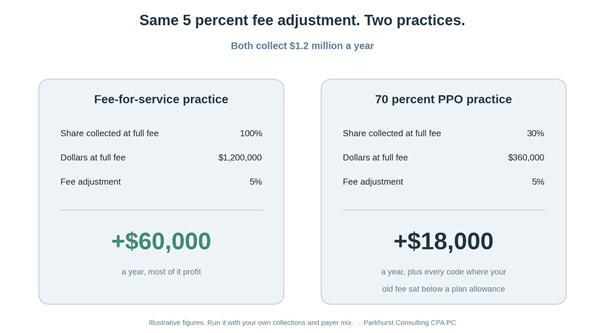
Even a practice with 70% of collections from PPO patients picks up about $18,000 a year, before counting codes that had slipped below a plan allowance.
How Much Should You Raise Your Dental Fees?
For most practices, 3 to 5% across the board is the right starting point. Then refine code by code, beginning with the changes patients barely feel:
- Fix any fee that sits below a PPO allowance first. The plan already agreed to pay that amount, so the patient's share barely moves and a quiet leak closes.
- Check your top codes against a current fee survey for your ZIP code, as part of your regular benchmarking, and bring low outliers up to market. A FFS practice should target the 80th percentile.
Your 90-Day Runway to January 1
A good fee update is a quarter of work, not an afternoon. Here is how we pace it:
- October: Rank your top 25 codes by revenue, with each PPO's allowance and the date you last changed each fee.
- November: Set the new fees, load them for January 1, and check how each PPO wants updates submitted.
- December: Brief the front desk, reprice your membership plan, and decide in writing how long accepted treatment plans keep this year's fees.
- January 1: Go live and check the first EOBs.
Give your team one sentence to use:
|
“Our fees adjust a small amount each January, the same way our costs do.” |
Frequently Asked Questions
How often should a dentist raise fees?
Once a year, effective January 1. A modest 3 to 5% adjustment keeps pace with costs and is easier on patients than a large catch-up.
Should I raise my fees if I am in network with PPOs?
Yes. Your full fee still sets what lesser-of claims pay and what out-of-network and uninsured patients pay.
Will patients leave if I raise my fees?
In our experience, a small, predictable yearly change rarely moves patients. A large catch-up does.
What Comes Next
Want your top 25 codes lined up against real fee survey data for your zip code? That is work we do every day! Weighing whether to stay in network at all? Start with our out-of-network break-even guide.
Not sure where to start? Contact us today!
General information for private practice owners, not legal or tax advice. Payer contracts and state law vary, so check your own agreements. Figures in the examples are illustrative.
References
American Dental Association, Health Policy Institute. (2026). The state of the U.S. dental economy: Third quarter 2026 update. https://www.ada.org/-/media/project/ada-organization/ada/ada-org/files/resources/research/hpi/state_us_dental_economy_q32026.pdf
Back to issue