



BUSINESS PLAN SERIES · STEP 7
Where dentistry is heading in 2026, and the four questions that place your practice inside it.
November 12, 2026
A question we hear from owners writing their first plan: "Does anyone actually read the industry section?" They do. It's where a lender, partner or buyer decides whether you understand the market your practice competes in.
The industry background section of a dental practice business plan answers four questions with real numbers: what the industry is, where it's heading, who you compete with, and how you'll adapt. Keep it to about a page, and tie every trend to a decision somewhere else in your plan.
It matters more in 2026. The ADA reports nearly two in five dentists weren't busy enough in the third quarter, up from about one in four in the second. Anyone reading your plan knows the market softened. This section is where you show you know it too, and what you're doing about it.
THE SHORT TAKE
- Answer four questions: what the industry is, where it's heading, who you compete with, how you'll adapt.
- Use dated numbers from named sources, not adjectives.
- Every trend you name should point to a decision in your plan.
- One page. Two at most.
What Goes in the Industry Background Section?
Four questions, one short paragraph each. Pull the national numbers from the ADA Health Policy Institute and the local ones from your market analysis in Step 4. The finished example further down shows all four answered in under 200 words.
The 2026 Numbers Worth Citing
Lenders don't need twenty statistics. They need the handful that explain your plan. These are the six we'd pull for a private practice today:
| Trend | The number | Source |
|---|---|---|
| Industry size | $189 billion in U.S. dental spending in 2024, up 4 percent after inflation | ADA HPI, national dental expenditures, 2026 |
| Patient demand | Consumer dental spending down 2.4 percent through August 2026 after inflation, and up 20 percent over ten years | ADA HPI, Q3 2026 (consumer spending) |
| Open capacity | Nearly 2 in 5 dentists not busy enough; new patients wait 12 days on average, down from 14.3 in 2024 | ADA HPI, Q3 2026 |
| Reimbursement | Up 19 percent since January 2021, while dental office pay rose 21 percent and equipment and supplies 23 percent | ADA HPI, Q3 2026 |
| Staffing | 88 percent of dentists recruiting a hygienist call it very or extremely challenging | ADA HPI, Q3 2026 |
| Ownership | 73 percent of dentists owned their practice in 2023, down from 85 percent in 2005; 16.1 percent were DSO affiliated in 2024, up from 7.2 percent in 2015 | ADA HPI, 2025 |
Read together, they say one thing: dentistry is a steady, slow-growing industry, and growth for a private practice now comes from taking share, not from a rising tide. Don't cite a statistic you can't tie to a decision.
Where Is Dentistry Heading?
1. Demand dipped this year, but the decade still points up. Consumer dental spending is down 2.4 percent in 2026 after inflation, and up 20 percent over ten years. Name the slow year. A lender trusts a plan that does.
2. Insurance fees trail practice costs. Since January 2021, insurance reimbursement rose 19 percent. Dental office pay rose 21 percent and equipment and supply prices 23 percent. The gap is small in any one year and real over five. If you're in network, show how your annual fee increase and payer mix close it.
3. Staffing is the real constraint. Open chairs and hard-to-fill hygiene jobs are the same problem from two sides. A plan that grows production without a hiring and retention budget won't hold up.
4. Ownership is delayed, not disappearing. Only 21 percent of dentists who graduated from 2016 to 2020 owned a practice five to nine years out, against 63 to 70 percent of those who graduated by 2010. If you're selling in the next decade, your buyer is likely a dentist who started in a group practice. Plan your transition around that.
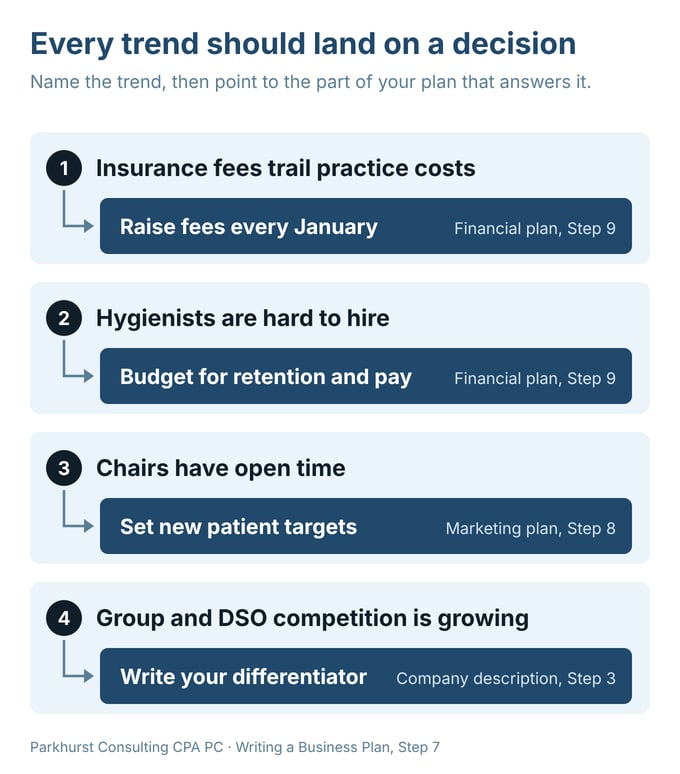
Every trend you name should land on a decision somewhere in your plan.
What the Fee Gap Costs in Dollars
Here's the reimbursement trend worked through for one in-network practice:
- 2021: $500,000 collected from insurance, $300,000 of team and supply cost to deliver that care, $200,000 left
- 2026, same patients and procedures: insurance pays $595,000 (up 19 percent)
- Team and supply cost: about $366,000 (up about 22 percent)
- What's left: $229,000, which buys what about $180,000 did in 2021
That's $29,000 more in dollars and about 10 percent less in buying power, for the same work. A plan that names this gap, and shows the fee and payer moves that close it, is the one a lender believes.
Who Do You Compete With?
Name them. "Several practices nearby" tells a reader nothing. List the five closest practices, whether each is solo, group or DSO, which networks they take, their hours, and one thing you do better.
Don't overstate the corporate threat, and don't ignore it. Nationally, 16.1 percent of dentists are DSO affiliated. In Texas it's closer to one in four, and Texas added 391,243 residents from July 2024 to July 2025, more than any other state. Our guide to competing with corporate dentistry covers where private practices win.
Example: A Finished Industry Background Section
Here's a finished version for a single-doctor general practice in Central Texas, about 60 percent PPO:
| Question | Example answer |
|---|---|
| What is the industry? | U.S. dental spending reached $189 billion in 2024. Consumer spending on dental care is up 20 percent over ten years after inflation, a steady, mature market. We're a single-doctor general practice offering preventive, restorative and cosmetic care. |
| Where is it heading? | Demand dipped in 2026, and nearly two in five dentists report open capacity. Insurance reimbursement has risen 19 percent since 2021 while team pay rose 21 percent. Hiring hygienists is the main limit on growth. |
| Who competes? | Eleven general practices within five miles, four of them DSO affiliated. None offer evening hygiene. Texas added more residents than any other state from 2024 to 2025, and our county grew faster than the state. |
| How will we adapt? | Raise fees 4 percent each January. Review our lowest-paying PPO with a break-even analysis by June 2027. Add Saturday hygiene to fill open chair time, and fund a hygienist retention bonus to keep it staffed. |
Notice the last row. Each response points to a page elsewhere in the plan: the fee schedule, the out-of-network break-even, the hours and the payroll budget. That's what makes the section worth reading.
Write It This Week: Four Steps
- Open the latest ADA dental economy update and copy the three numbers that matter most to your practice.
- List your five closest competitors and their model.
- Write one short paragraph per question, using the example above.
- Next to each trend, name the decision it drives. If a trend drives no decision, cut it.
Frequently Asked Questions
What goes in the industry background section of a dental business plan?
What the dental industry is, where it's heading, who you compete with, and how your practice will adapt. Use current, sourced numbers and tie each trend to a decision in the rest of your plan.
How long should the industry background section be?
About one page. Lenders want proof you understand the market, not a research report, so keep the statistics to the handful that explain your plan.
Where can I find dental industry statistics for a business plan?
Start with the American Dental Association's Health Policy Institute, which publishes national spending, workforce and quarterly dental economy data. Use the U.S. Census Bureau for population growth in your area.
What Comes Next
The industry won't hand a private practice growth in 2026. Your plan has to show where it comes from. Step 8 covers the marketing plan: how you'll bring in the patients to fill the chair time this section uncovers. Until then, our guide to marketing for FFS and PPO practices is a good place to start.
If you'd like help pulling the numbers for your market, or reading what they mean for your practice, that's the work we do with practice owners every day.
Not sure where to start? Contact us today!
General information for private practice owners, not legal or tax advice. The example practice and the fee gap figures are illustrative.
References
- American Dental Association, Health Policy Institute. (2025, June). Practice ownership trends in dentistry: A new look at old data. https://www.ada.org/-/media/project/ada-organization/ada/ada-org/files/resources/research/hpi/practice_ownership_trends_dentistry_new_look_old_data.pdf
- American Dental Association, Health Policy Institute. (2025, August). The U.S. dentist workforce. https://www.ada.org/-/media/project/ada-organization/ada/ada-org/files/resources/research/hpi/US_dentist_workforce_2025.pdf
- American Dental Association, Health Policy Institute. (2026). National dental expenditures, 2024. https://www.ada.org/resources/research/health-policy-institute/dental-care-market/national-dental-expenses
- American Dental Association, Health Policy Institute. (2026). The state of the U.S. dental economy: Third quarter 2026 update. https://www.ada.org/-/media/project/ada-organization/ada/ada-org/files/resources/research/hpi/state_us_dental_economy_q32026.pdf
- U.S. Census Bureau. (2026, January 27). U.S. population growth slows due to historic decline in net international migration. https://www.census.gov/newsroom/press-releases/2026/population-growth-slows.html